ROMINE
Strategic & Psychic Intelligence
AI and Intuition: What Actually Changes When You Put a Decision in Front of a Machine
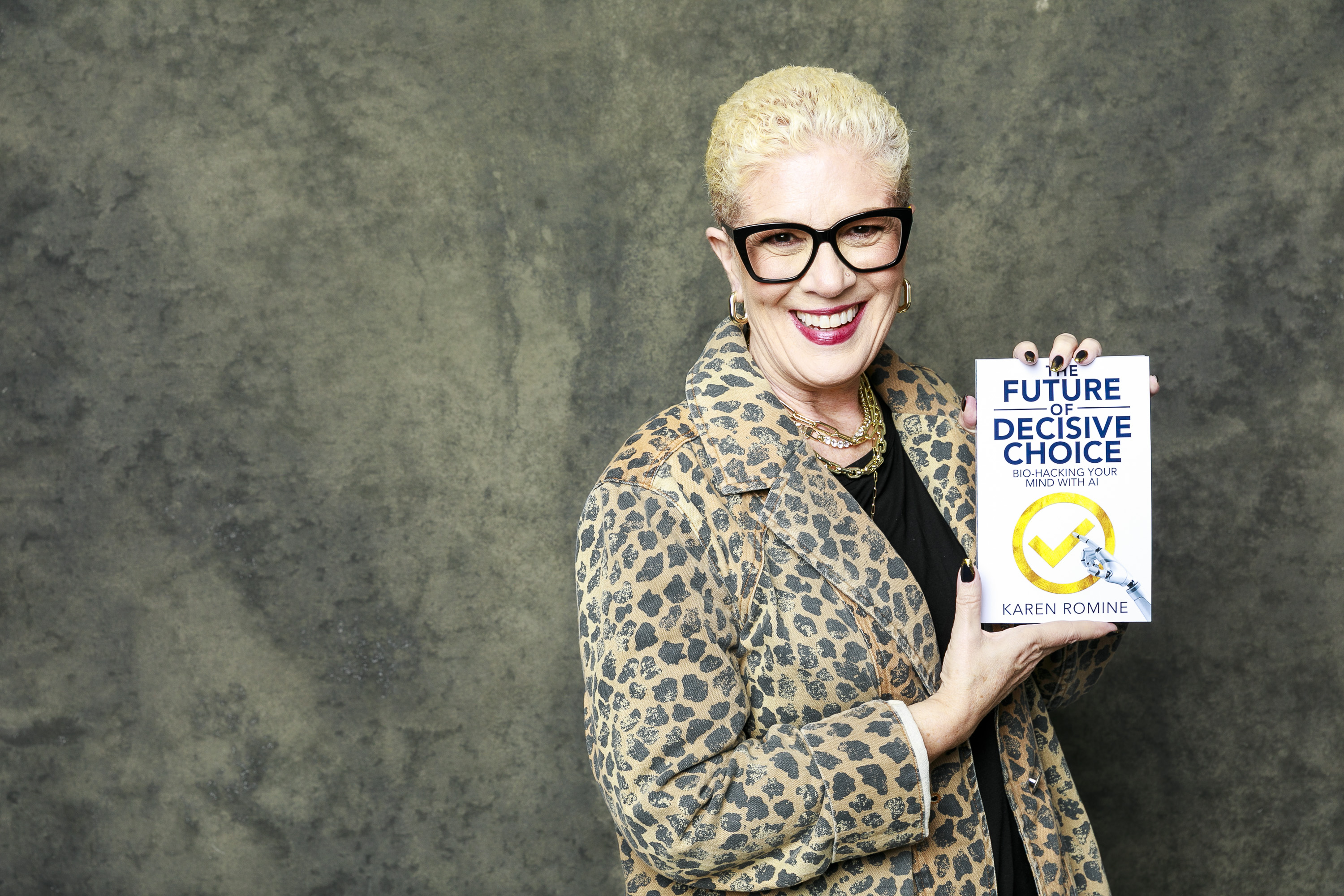
By Karen Romine · September 8, 2026
I hate journaling.
Four decades in business and I never found a notebook that helped. I would write everything down and the words would sit there, more alive for having been written, and nothing would move.
One evening I did it anyway. I was drained. Every decision, large and small, had started to feel impossible. I sat in the dark and spilled all of it out. Frustration, confusion, questions about work and purpose and timing.
Then I copied the whole thing into ChatGPT.
The first answers were flat. Useful the way a summary is useful, which is barely. Then I changed how I was asking, and what came back changed with it.
There was nobody to argue with. Nobody to reassure. Nobody whose feelings I had to manage while I worked out what I actually thought. My own words came back to me from an angle I could not have reached on my own.
The thing no advisor can do
I have worked with coaches. I have sat in masterminds. I have friends who will tell me the truth without softening it.
None of them had my entire history in front of them at once.
None could hold the way I make decisions, what I say I value, what I wanted a year ago, and what I keep circling without committing to, all in the same moment. That is a limit of being a person with a life of your own. It is not a failing of anyone who has ever advised me.
The machine had no such limit.
Over the following weeks it surfaced patterns I had carried for years without naming them. It found connections between decisions I had filed in separate parts of my life, as though those parts were not the same person.
At the end of it, I decided not to retire.
That choice is the reason this practice exists.
What is actually happening
The word "AI" now covers everything from a spreadsheet formula to a claim about consciousness, so let me be precise about the mechanism.
I am describing a mirror with a memory. The decision stays where it always was, which is with me.
Here is why that matters more than it sounds.
Intuition is real and it is fallible. Mine is trained on four decades of rooms, deals, and people. It is also shaped by whatever I happen to be afraid of that week. Those two things arrive in the body identically, and in the moment I could never reliably tell them apart.
That separation is the work the machine took over.
It does not know more than I do about my own life. It holds more of what I know at once than I can hold myself, and it holds it without flinching, without an opinion about how I should feel, and without needing anything from me.
Decision fatigue is the real reason this works
There is a measurable version of this problem. Decision quality degrades across a day of deciding. Roy Baumeister's research established it decades ago and every operator recognizes it without needing the citation.
By the time a founder reaches the decision that genuinely matters, the mental energy that decision deserves has already gone to forty smaller ones that did not deserve it.
The machine does not get tired at four in the afternoon. That is most of the advantage right there.
Where it fails
I would not trust this account if it left out the limits.
AI is confident when it is wrong, and it is most confident in exactly the register that sounds like insight. It will agree with you if you ask leading questions, so the quality of what comes back is set almost entirely by the quality of what goes in.
It has no stake in your life. It will not volunteer that the situation you are describing is a pattern it has watched you repeat for three years, unless you have given it three years of material and asked it to look.
And it cannot do the thing I do with a client, which is sit inside a decision that cannot be reversed and read what is already moving around it.
Why this matters for a decision you cannot undo
Founders and serial entrepreneurs bring me decisions at the point where the model has been run, the diligence is finished, the advisors have spoken, and the thing still will not settle. Something is incomplete, and it is almost never more information.
For years the honest answer to "how do you know" was that I had spent four decades learning to read a room, and that I could not show my work.
AI did not change what I know. It changed how much of it I can see at once, and how quickly I can separate the signal from the fear.
That is the argument of the book. It is also how I work.
Read next: Build Your Own Invisible Council, the prompt I run when a decision matters.
Karen Romine is a psychic medium and strategic advisor to founders and serial entrepreneurs. Four decades in corporate leadership, including more than $400 million in mergers and acquisitions. Local law enforcement and the FBI bring her missing-person and cold cases. She is the author of The Future of Decisive Choice: Bio-Hacking Your Mind With AI and the founder of The Black Table.
Navigation
Connect


Photography: Matt Stasi Photography